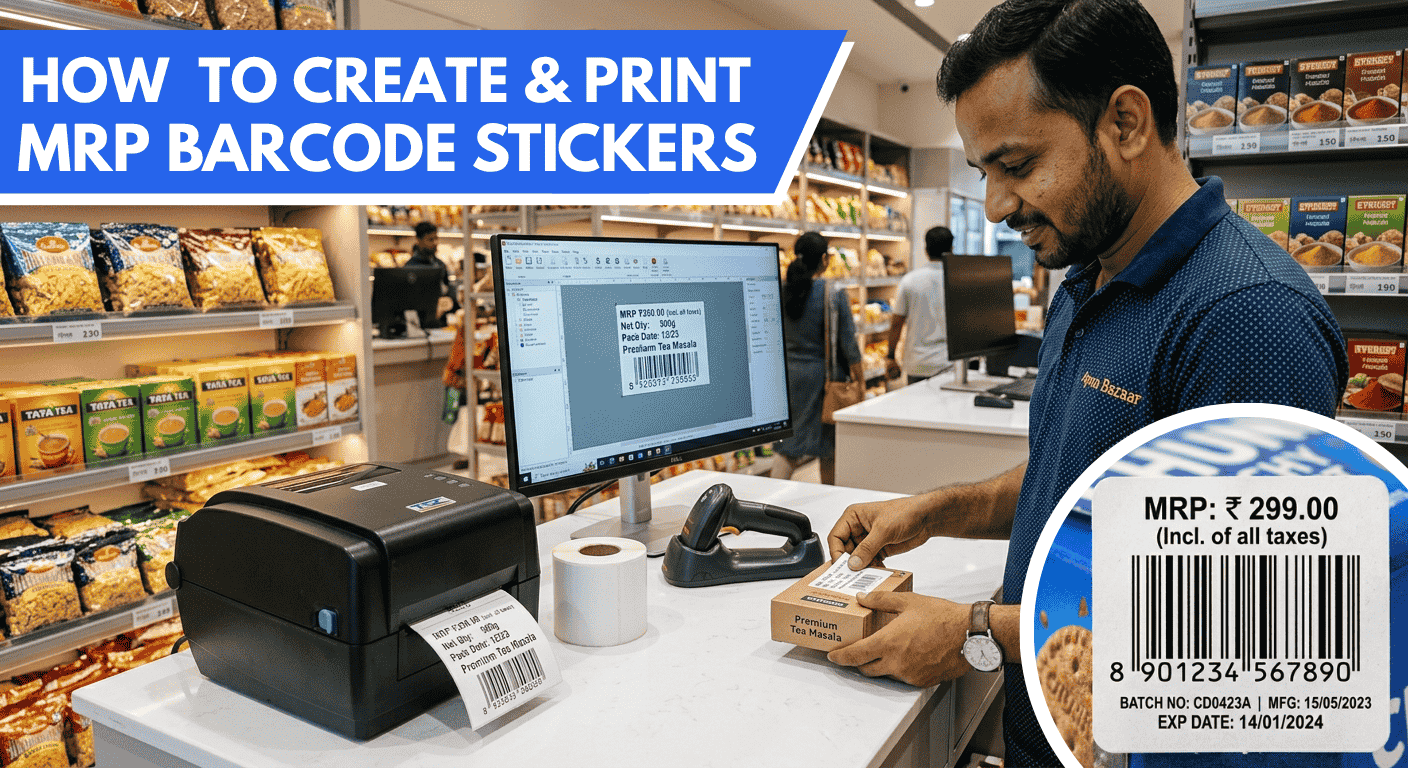
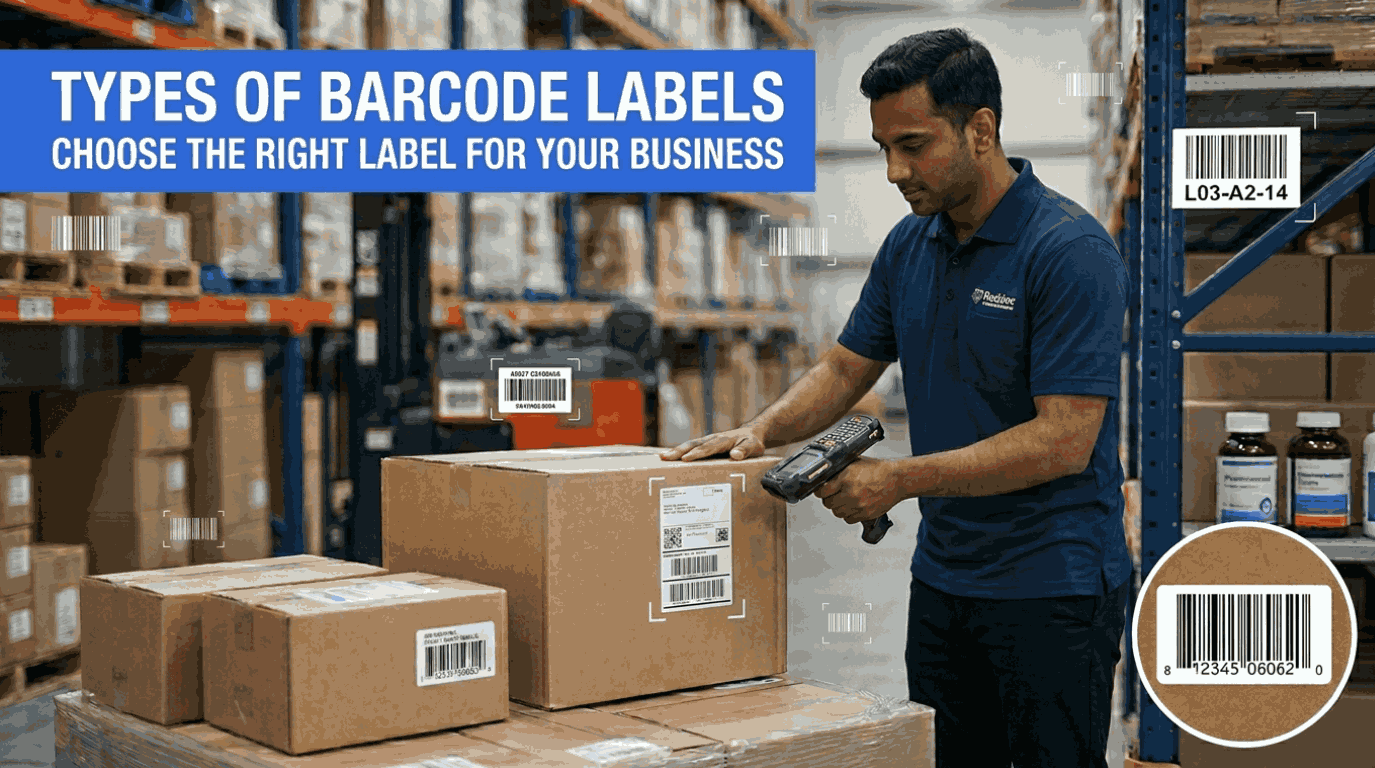
Barcode stickers have become an essential part of modern business operations, helping companies manage products, track inventory, and reduce manual errors. From retail stores and warehouses to manufacturing units and healthcare facilities, these labels ensure faster processes, accurate identification, and smoother day-to-day workflows.
However, not all barcode stickers are the same. Choosing the wrong type, material, or adhesive can lead to issues like poor scanning, label damage, or peeling during use. Many businesses face operational problems not because of their systems, but because the labels they use are not suited to their environment or application.
In this guide, you’ll learn everything about barcode stickers from their types and materials to real-world applications and selection factors. This will help you make informed decisions and choose the right labels for your business needs. If you want to understand the technical side as well, you can explore our guide on types of barcodes.
What Are Barcode Stickers? (Definition & Business Importance)
Barcode stickers are physical labels that contain printed barcodes, used by businesses to identify, track, and manage products or assets efficiently. These stickers are applied to items, packaging, shelves, or equipment so they can be scanned quickly using a barcode scanner or system.
It’s important to understand the difference between a barcode and a barcode sticker. A barcode is simply the machine-readable code itself, while a barcode sticker is the complete label that carries that code along with supporting information, such as product name, price, SKU, or batch details. In day-to-day operations, businesses interact with the sticker not just the code.
Businesses today rely heavily on barcode labels to streamline operations, reduce errors, and improve tracking efficiency.
Why Barcode Stickers Matter for Businesses
Barcode stickers play a critical role across multiple industries because they simplify identification and eliminate manual errors.
- Retail (Supermarkets, Clothing Stores):
Every product has a barcode sticker that allows quick billing at checkout. Without it, billing would rely on manual entry, increasing errors and slowing down queues. - Logistics & Warehousing:
In warehouses, barcode stickers are used on cartons, shelves, and pallets. This helps staff instantly locate items, track inventory movement, and reduce misplacement. - Manufacturing:
Barcode stickers are applied to raw materials, semi-finished goods, and finished products. This ensures proper tracking throughout production and helps maintain quality control. - Healthcare & Pharmaceuticals:
Hospitals and pharmacies use barcode stickers to track medicines, patient records, and lab samples where accuracy is critical and mistakes can be costly.
Practical Business Value
Using barcode stickers is not just about automation it directly impacts business performance:
- Faster operations: Scanning takes seconds compared to manual entry
- Reduced human error: Eliminates mistakes in product identification
- Better inventory control: Real-time tracking of stock levels
- Improved customer experience: Faster billing and fewer errors
For example, a retail store without barcode stickers may struggle with long billing times and pricing mistakes, while a warehouse without proper labeling may face inventory mismatches and delays in order fulfillment.
Why Quality Matters
Not all barcode stickers perform the same. Poor-quality labels can fade, peel off, or fail to scan, leading to operational issues. This is why businesses often choose reliable suppliers like Suman Labels, who focus on producing durable and scannable barcode stickers suited for real-world conditions.
In short, barcode stickers are a small component of a product but they play a major role in ensuring smooth, accurate, and scalable business operations.
Types of Barcode Labels Based on Use Cases
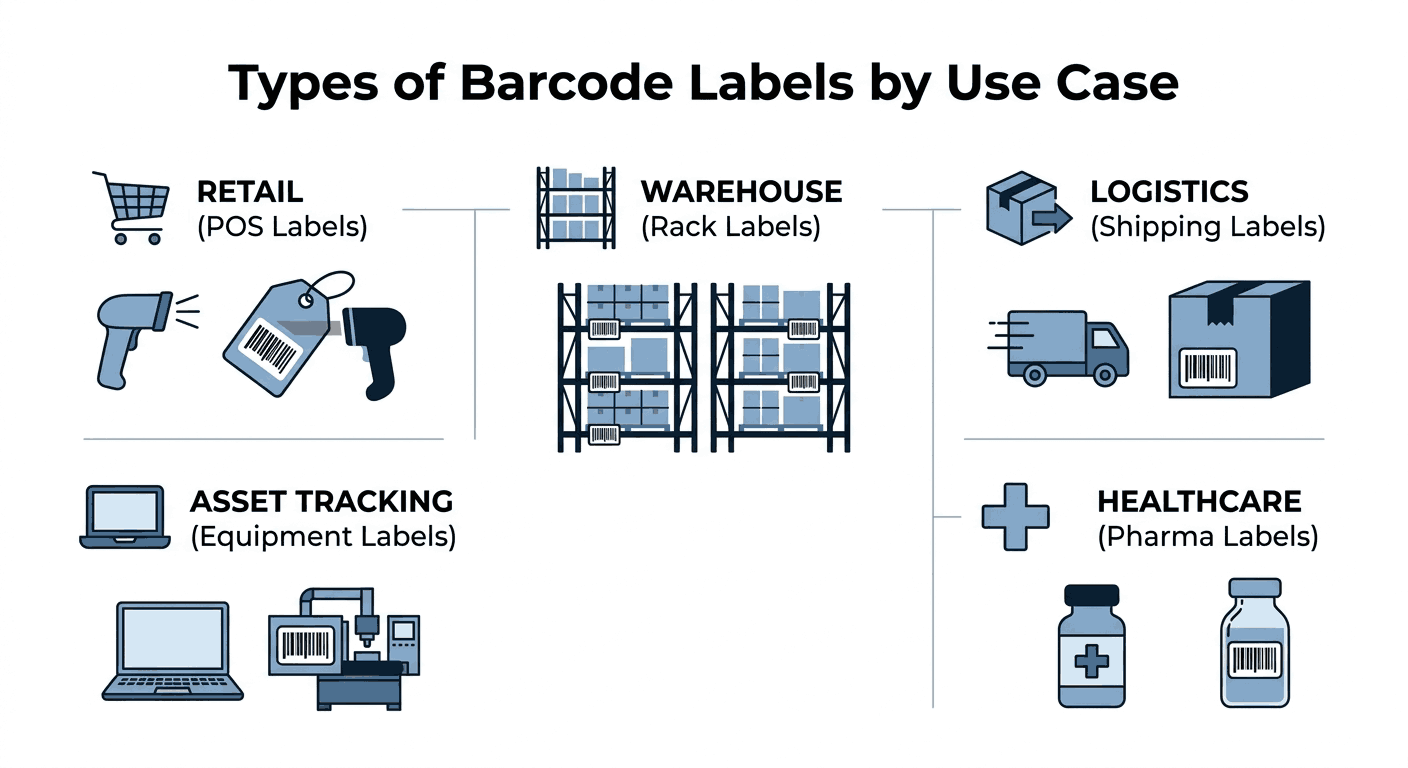
When choosing barcode stickers, it’s important to understand that they are not classified by barcode format, but by where and how they are used in real business operations. Different industries require different types of labels based on durability, scanning needs, and environmental conditions.
Understanding the types of barcode labels based on use cases helps businesses select the right label for their specific workflow, reducing errors and improving efficiency.
Retail Barcode Labels
Retail barcode labels are commonly used on products in supermarkets, clothing stores, and electronics shops. These labels are designed for point-of-sale (POS) scanning, where speed and accuracy are critical.
They usually include:
- Product name
- Price or MRP
- SKU (Stock Keeping Unit)
In a busy retail environment, even a small scanning delay can affect customer experience. That’s why these labels are typically designed for clear print quality and fast scanning, ensuring smooth billing operations. Many businesses prefer custom printed labels to include branding, product details, and better visual identification.
Inventory & Warehouse Labels
Inventory and warehouse labels are used for stock management, shelf labeling, and product tracking inside storage facilities. Unlike retail labels, these need to be scanned from a distance, especially in large warehouses.
Key requirements include:
- High contrast for long-range scanning
- Strong readability even in low light
- Durable material to handle frequent handling
For example, in a logistics warehouse, barcode labels are placed on racks and cartons to help workers quickly locate and move items without confusion.
Shipping & Logistics Labels
Shipping and logistics labels are applied to packages, cartons, and courier shipments. These labels go through multiple handling stages, including transportation, sorting, and delivery.
Because of this, they require:
- Strong adhesive to stay intact during transit
- Resistance to dust, moisture, and rough handling
- Clear scanning across different checkpoints
A poorly printed or weak label can result in delivery delays or lost shipments, which directly impacts customer satisfaction. For high-volume shipping operations, many businesses prefer thermal barcode labels because they offer fast printing and cost-effective labeling for courier and logistics workflows.
Asset Tracking Labels
Asset tracking labels are used by businesses to manage fixed assets such as computers, machinery, office equipment, and tools. These labels help in tracking ownership, maintenance, and movement of assets.
Common use cases include:
- IT companies tracking laptops and servers
- Manufacturing units tracking machinery
- Offices managing equipment inventory
These labels often need to be long-lasting and tamper-resistant, as they are used over extended periods.
Healthcare & Pharmaceutical Labels
In healthcare and pharmaceutical industries, barcode labels are used for medications, lab samples, patient identification, and medical equipment. Accuracy here is critical, as even a small error can lead to serious consequences.
These labels are designed to:
- Maintain high scanning accuracy
- Comply with regulatory standards
- Remain readable despite handling and storage conditions
For example, hospitals use barcode labels on patient wristbands and medicine packaging to ensure correct identification and avoid mix-ups.
Practical Takeaway
Each business environment has different requirements, and using the wrong type of barcode label can lead to operational issues. For instance, using retail labels in a warehouse may result in poor scanning from a distance, while using low-quality labels in logistics can cause them to peel off during transit.
By selecting the right type based on your use case, businesses can improve efficiency, reduce errors, and ensure smooth operations across departments.
Barcode Label Materials Explained (Durability Guide)
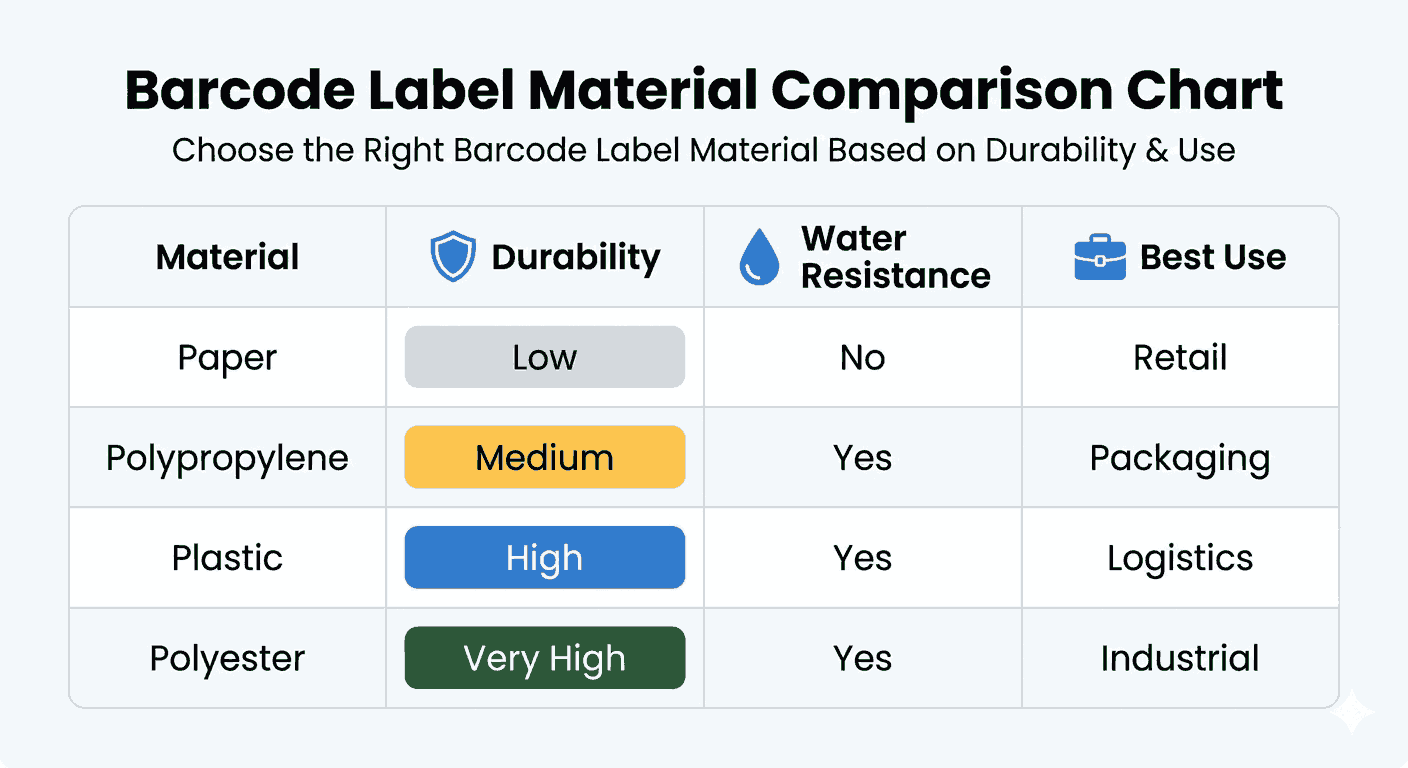
The material of a barcode sticker directly impacts its lifespan, durability, print quality, and overall cost. Choosing the wrong material can lead to fading prints, peeling labels, or scanning failures especially in demanding environments like warehouses or outdoor logistics.
For example, a retail store may only need short-term labels for fast-moving products, while a manufacturing unit may require labels that can withstand heat, moisture, and chemicals. This is why understanding material options is essential before making a decision.
Paper Labels
Paper labels are the most commonly used and cost-effective option for businesses that need short-term barcode applications. They are widely used in retail, packaging, and basic inventory tagging where labels are not exposed to harsh conditions.
Key characteristics:
- Low cost, ideal for bulk usage
- Smooth surface for clear barcode printing
- Best suited for indoor use
Paper-based plain labels are commonly used for basic applications like packaging and temporary identification.
Real-world example:
In supermarkets, most product barcode stickers are paper-based because items are sold quickly and don’t require long-term durability.
When to choose paper labels:
- You need labels for short-term use
- Products are stored in dry, indoor environments
- Cost is a major factor
When to avoid:
- Outdoor usage
- Exposure to water, oil, or rough handling
Plastic Labels
Plastic labels are designed for durability and are suitable for environments where paper labels would fail. These include applications involving moisture, friction, or extended usage.
plastic barcode labels are commonly used in logistics, manufacturing, and industries where labels must remain intact and scannable over time.
Key benefits:
- Water-resistant and tear-proof
- Longer lifespan compared to paper
- Suitable for rough handling and transportation
Real-world example:
In courier and logistics companies, packages often go through multiple handling stages. Plastic labels ensure the barcode remains readable throughout the journey.
When to choose plastic labels:
- Labels are exposed to moisture or outdoor conditions
- Products require long-term identification
- Durability is more important than cost
When to Avoid:
- Short-term usage
- Indoor environments with no moisture or damage risk
- High-volume applications where cost matters
Polyester Labels
Polyester labels are a premium option used in industrial and high-performance environments. These labels are built to withstand extreme conditions where other materials may fail.
Key features:
- Resistant to heat, chemicals, and abrasion
- Long-lasting adhesive
- Ideal for industrial equipment and machinery
Real-world example:
Manufacturing units use polyester labels on machines and components where labels must last for years without fading or peeling.
When to choose polyester labels:
- High-temperature environments
- Chemical exposure
- Long-term asset labeling
When to Avoid:
- Basic retail or packaging use
- Low-budget requirements
- Applications with no heat or chemical exposure
Polypropylene Labels
Polypropylene labels offer a balance between paper and polyester labels. They are more durable than paper but more cost-effective than polyester, making them a practical mid-range option.
Key advantages:
- Flexible and moderately durable
- Resistant to moisture and minor wear
- Suitable for semi-long-term applications
Real-world example:
E-commerce businesses often use polypropylene labels for packaging where durability is needed, but extreme conditions are not involved.
When to choose polypropylene labels:
- Moderate durability is required
- Budget constraints exist but paper is not sufficient
- Labels face occasional handling or moisture
When to Avoid:
- Extreme heat or chemical exposure
- Heavy abrasion or rough industrial use
- Long-term labeling (multiple years)
Practical Decision Guide
- Short-term, low-cost needs → Paper labels
- Medium durability → Polypropylene labels
- High durability → Plastic or polyester labels
Choosing the right material ensures your barcode stickers remain readable, intact, and reliable, preventing scanning errors and operational disruptions.
Real-World Barcode Label Examples (How They Are Used in Business)
Seeing how barcode stickers are used in real business scenarios makes it easier to choose the right type for your operations. Below are practical, real-world barcode label examples that show how different industries rely on them daily.
Retail Store: Fast Checkout & Inventory Sync
In a clothing or supermarket store, every product has a barcode sticker attached to its packaging or tag. When scanned at checkout, the system instantly retrieves pricing, product details, and stock levels.
What this solves:
- Eliminates manual price entry
- Reduces billing errors
- Keeps inventory updated in real time
Example: A supermarket processes hundreds of items per hour using barcode labels, ensuring quick billing and accurate stock tracking.
Warehouse: Quick Item Location & Picking
In warehouses, barcode labels are placed on storage racks, bins, and cartons. Workers scan these labels to locate items and confirm correct picking during order fulfillment.
What this solves:
- Faster order processing
- Reduced picking errors
- Better inventory visibility
Example: A logistics warehouse uses barcode-labeled racks so staff can find products within seconds instead of searching manually.
Courier & Logistics: Real-Time Shipment Tracking
Every parcel in a courier system carries a barcode label that is scanned at multiple checkpoints from pickup to delivery. This enables real-time tracking of shipments.
What this solves:
- Accurate shipment tracking
- Reduced chances of lost parcels
- Faster sorting at hubs
Example: A delivery company scans packages at each transit point, updating tracking status instantly for customers.
Manufacturing: End-to-End Product Traceability
In manufacturing units, barcode labels are applied to raw materials, components, and finished goods. These labels help track items throughout the production process.
What this solves:
- Ensures correct parts are used
- Tracks production stages
- Improves quality control
Example: A factory uses barcode stickers on components to monitor their movement across assembly lines and reduce production errors.
How to Apply This in Your Business
These examples show that barcode labels are not just for identification they are essential for speed, accuracy, and control in business operations.
By understanding how they are used in real scenarios, you can better decide:
- Where labels will be applied
- What level of durability is needed
- How critical scanning accuracy is for your workflow
Choosing the right barcode label based on actual usage ensures smoother operations and fewer costly mistakes.
How to Choose the Right Barcode Label
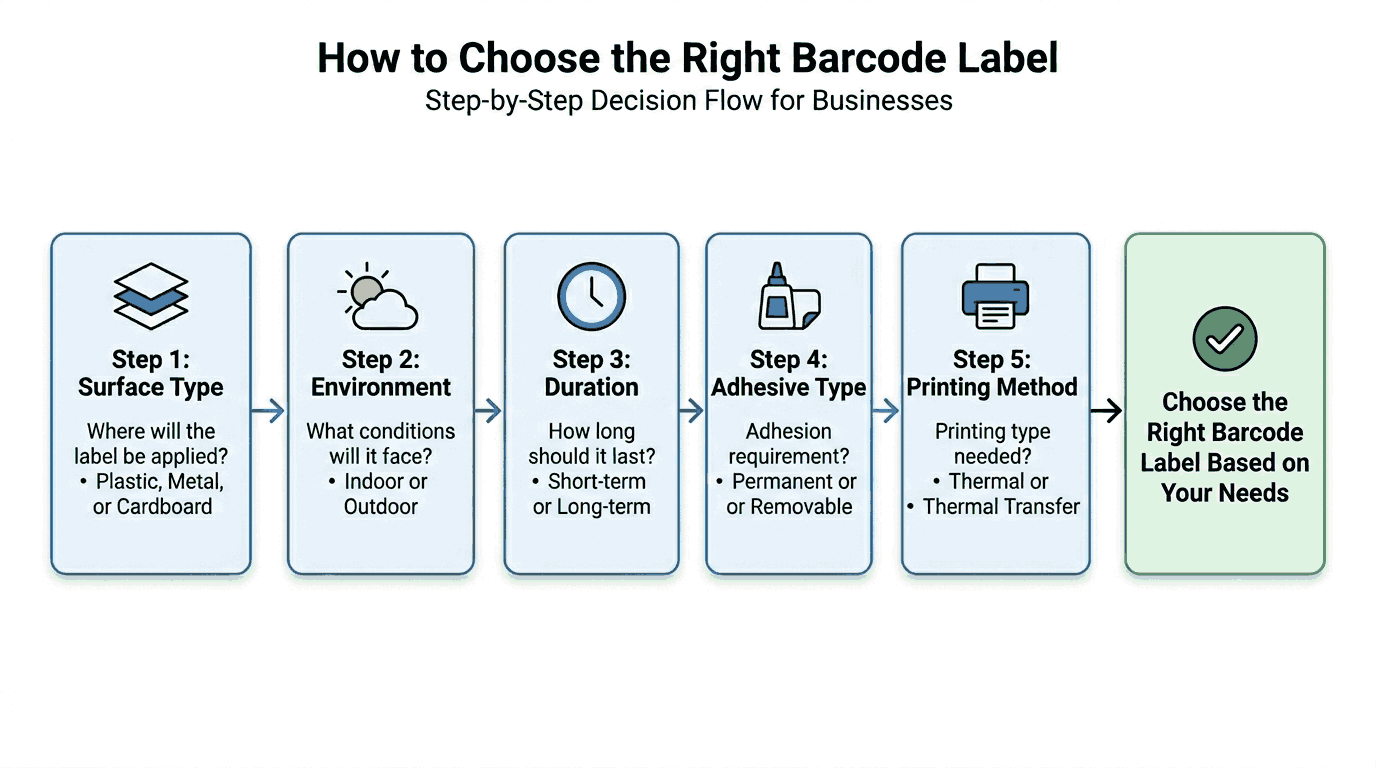
Choosing the right barcode stickers is not just about printing a code it directly affects scanning accuracy, durability, and day-to-day operations. A wrong choice can lead to labels peeling off, fading, or failing to scan, which slows down workflows and creates costly errors.
Below are the key factors every business should evaluate before selecting barcode labels.
Surface Type
The surface where the label will be applied plays a major role in performance. Different materials require different adhesives and label types.
- Plastic surfaces: Smooth but may need strong adhesive for long-term sticking
- Metal surfaces: Can face heat or friction, requiring durable labels
- Cardboard surfaces: Easy to stick, commonly used in packaging and shipping
Practical tip:
If labels are being applied to rough or uneven surfaces, choose a stronger adhesive to prevent peeling over time.
Environmental Conditions
Consider the environment where the labels will be used and stored. Exposure to external factors can affect both the label material and print quality.
- Heat: Can cause fading or adhesive failure
- Moisture: May damage paper labels or cause peeling
- Chemicals: Can degrade print and material
Real-world example:
In warehouses without climate control, labels may be exposed to humidity and dust, making durable materials a better choice than basic paper labels.
Durability Requirements
Not all barcode stickers need to last the same amount of time. Choosing based on lifespan helps balance cost and performance.
- Temporary use: Suitable for retail or fast-moving goods
- Medium-term use: Inventory and logistics applications
- Long-term use: Asset tracking and industrial labeling
Practical tip:
Avoid overpaying for highly durable labels if your products are sold quickly, but don’t compromise on quality for long-term applications.
Adhesive Type
The adhesive determines how well the label sticks and whether it can be removed.
- Permanent adhesive: Strong bond, difficult to remove
- Removable adhesive: Can be peeled off without residue
Real-world example:
Retail stores often use removable labels for pricing, while logistics companies prefer permanent adhesive to ensure labels stay intact during transit.
Print Quality & Scannability
Even the best label material is ineffective if the barcode cannot be scanned properly. Print quality directly impacts scanning speed and accuracy.
- Ensure high contrast between barcode and background
- Avoid smudging or fading
- Maintain proper barcode size and spacing
Practical tip:
Poor print quality can lead to repeated scanning attempts, slowing down operations in retail billing or warehouse picking. For long-lasting and high-quality prints, businesses often use thermal transfer ribbons, especially in industrial and outdoor applications.
What This Means for Your Business
Selecting barcode stickers should be based on where they are used, how long they need to last, and the conditions they will face. For example:
- A retail store may prioritize cost and speed
- A logistics company may focus on durability and adhesion
- A manufacturing unit may need labels that withstand heat and chemicals
By evaluating these factors carefully, businesses can reduce errors, improve efficiency, and avoid unnecessary costs caused by poor label performance.
Common Mistakes to Avoid When Selecting Barcode Labels
Choosing barcode labels may seem simple, but small mistakes can lead to scanning failures, label damage, and operational delays. Many businesses face issues not because of the barcode system itself, but due to incorrect label selection.
Here are the most common mistakes and how to avoid them.
Choosing the Wrong Material
One of the biggest mistakes is selecting a label material that doesn’t match the application. For example, using paper labels in a high-moisture or rough environment can cause them to tear or fade quickly.
Real-world impact:
In logistics, a damaged label can make a package unscannable, leading to delays or lost shipments.
How to avoid:
Match the material to the use case paper for short-term use, and durable materials like plastic or polyester for long-term or harsh conditions.
Ignoring Environmental Conditions
Many businesses overlook where the label will be used. Factors like heat, humidity, dust, and chemicals can affect both the label and the print.
Real-world impact:
In warehouses with high humidity, labels may peel off or become unreadable if the wrong material is used.
How to avoid:
Always consider the environment before choosing labels. If labels are exposed to outdoor or industrial conditions, opt for materials designed to handle those challenges.
Poor Adhesive Selection
Even a high-quality label can fail if the adhesive is not suitable for the surface or usage.
Real-world impact:
In shipping, labels with weak adhesive may come off during transit, making it impossible to track the package.
How to avoid:
Choose adhesive based on the surface (plastic, metal, cardboard) and whether the label needs to be permanent or removable.
Low-Quality Printing
A barcode is only useful if it scans correctly. Poor print quality such as low contrast, smudging, or fading can lead to repeated scanning attempts or complete failure.
Real-world impact:
In retail stores, low-quality printing slows down billing and frustrates both staff and customers.
How to avoid:
Use proper printing methods and ensure high contrast and clarity. Regularly check print quality to maintain consistent scanning performance.
What This Means for Your Business
Avoiding these common mistakes helps ensure that your barcode labels remain reliable, scannable, and durable in real working conditions. A small improvement in label selection can lead to:
- Faster operations
- Fewer errors
- Better inventory control
Taking the time to choose the right barcode labels not only improves efficiency but also prevents unnecessary costs and disruptions in your business workflow.
Many printing issues arise due to incorrect setup, and learning How to Print MRP Sticker with Barcode can help businesses avoid common formatting and scannability mistakes.
Where to Buy High-Quality Barcode Stickers in India
Choosing the right supplier is just as important as selecting the right type of barcode label. A reliable manufacturer ensures consistent print quality, strong adhesion, and durability, which directly impacts scanning accuracy and day-to-day operations.
If you’re looking for reliable barcode labels in mumbai, Suman Labels offers high-quality solutions tailored for retail, logistics, and industrial applications.
What to Look for in a Barcode Label Supplier
Before finalizing a supplier, consider these key factors:
- Material quality: Labels should match your application whether short-term retail use or long-term industrial use
- Print precision: Clear, high-contrast barcodes for fast and accurate scanning
- Adhesive strength: Suitable for different surfaces like plastic, metal, or cardboard
- Customization options: Size, material, and format based on your business needs
- Consistent supply: Ability to handle bulk orders without quality variation
Why Supplier Quality Matters
Inconsistent labels can cause:
- Scanning errors at checkout or during inventory tracking
- Labels peeling off during transit
- Operational delays in warehouses or production lines
Working with an experienced supplier helps avoid these issues and ensures smooth business operations.
Suman Labels focuses on durability, precision printing, and consistent quality to meet business requirements across industries. With experience in serving retail, logistics, and manufacturing sectors, the brand understands practical challenges and delivers solutions that perform reliably in real-world conditions.
Practical Tip
Before placing a bulk order, always test sample labels in your actual working environment. This helps ensure the labels meet your durability and scanning requirements, avoiding costly mistakes later.
Conclusion: Choosing the Right Barcode Sticker for Your Business
Selecting the right barcode sticker is not just a technical decision it directly impacts how smoothly your business operates. From material and adhesive to print quality and environmental suitability, every factor plays a role in ensuring your labels remain durable, scannable, and reliable.
To make the right choice, focus on:
- Where the label will be applied (surface type)
- Conditions it will face (heat, moisture, handling)
- How long it needs to last (temporary vs long-term)
- The level of print clarity required for accurate scanning
A well-chosen barcode sticker helps reduce errors, speeds up operations, and improves overall efficiency whether you’re managing a retail store, warehouse, or manufacturing unit.
On the other hand, using the wrong label can lead to peeling, fading, or scanning issues, which can disrupt workflows and increase operational costs.
If you’re unsure which type of barcode sticker suits your business, it’s always a good idea to evaluate your specific use case and test samples before making a decision. Working with experienced providers like Suman Labels can also help ensure you get labels that perform reliably in real-world conditions.
Ultimately, the right barcode sticker is one that fits your environment, supports your workflow, and helps your business run more efficiently.
Frequently Asked Questions
1. What is the difference between a barcode and a barcode sticker?
A barcode stores product information in a machine-readable pattern, while a barcode sticker is the physical label that displays the barcode along with details like price, SKU, or product identification.
2. What are the most durable barcode labels?
Plastic and polyester barcode labels offer the highest durability. They resist water, heat, chemicals, and rough handling, making them ideal for logistics, manufacturing, and outdoor applications that require long-term performance.
3. Which barcode labels are best for retail use?
Retail businesses commonly use paper-based barcode labels because they are cost-effective and suitable for short-term use. These labels perform well in indoor environments where products sell quickly and do not need long-lasting durability.
4. Can barcode stickers be customized?
Yes, businesses can customize barcode stickers based on their needs. You can select different sizes, materials, adhesives, and add branding elements like logos, product details, or color variations for better identification and presentation.
5. How do I choose the right barcode label for my business?
Choose the right barcode label by evaluating where you will use it, the environmental conditions, required durability, adhesive strength, and printing method. When you align these factors correctly, you achieve better performance, accurate scanning, and fewer operational issues.</p>
6. Do barcode labels work in outdoor conditions?
Yes, but only if you use weatherproof or durable materials like plastic or polyester. Standard paper labels may fade or peel when exposed to sunlight, rain, or dust, making them unsuitable for outdoor applications.
7. Why are my barcode labels not scanning properly?
Barcode labels may fail to scan due to poor print quality, low contrast, incorrect sizing, or damage like smudging and fading. Ensuring proper printing settings and using quality materials helps maintain consistent and accurate scanning performance.