
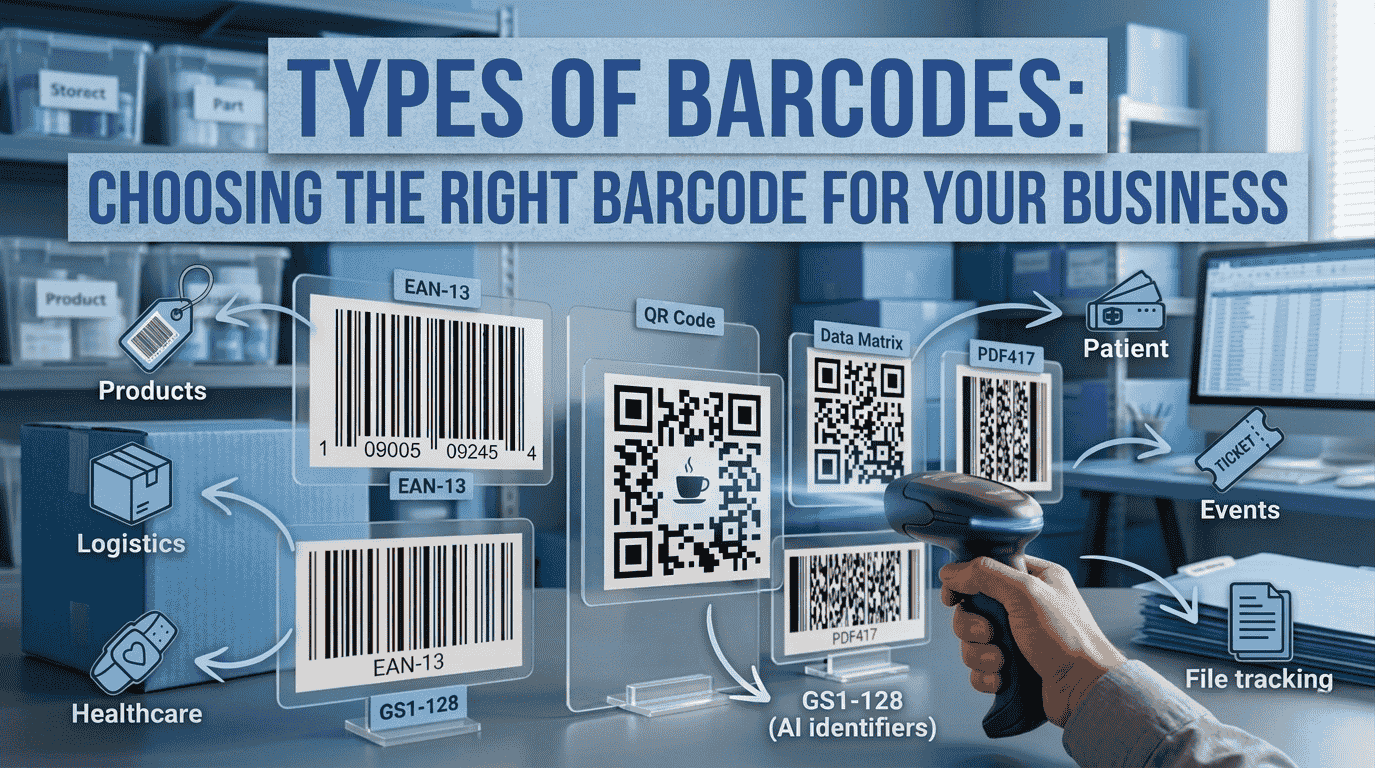
Barcodes play a crucial role in modern business operations, enabling fast product identification, accurate inventory management, and seamless supply chain tracking. From retail stores to warehouses and manufacturing units, almost every industry relies on barcodes to improve efficiency and reduce human errors.
But with multiple barcode types available, choosing the right one can be confusing. Businesses often struggle to decide between 1D vs 2D barcode, select the correct format, or understand which barcode suits their specific use case.
In this guide, we’ll break down the different types of barcodes, explain how they work, and help you choose the right barcode for your products, packaging, and business needs. Whether you’re labeling retail items, managing logistics, or looking for reliable barcode labels, this guide will give you a clear and practical understanding to make the right decision.
What is a Barcode
A barcode is a machine-readable code used to store product information in the form of lines, patterns, or symbols. In simple terms, it acts as a unique identifier that can be scanned to retrieve data instantly.
The barcode definition refers to a visual representation of data that can be read by a scanner and linked to product details in a system. You commonly see a product barcode on items in stores, which helps in quick billing and inventory tracking.
Barcode Definition and Meaning
A barcode is a scannable code that represents data using lines, spaces, or patterns. It is used to quickly identify and track products in retail, logistics, and manufacturing.
Barcode Full Form and Structure
The barcode full form is commonly referred to as Binary Array of Lines and Bars Code.
A barcode is made up of:
- Black bars and white spaces (data encoding)
- Varying widths (to represent different values)
- Numbers below the code (human-readable format)
These elements work together to store and communicate product information visually.
How Barcodes Store Information
Barcodes store information using a combination of patterns and spacing that scanners can read.
Here’s how it works:
- Each bar and space represents a specific value
- The pattern forms a unique barcode number
- The scanner reads the pattern using light
- The system matches it with stored product data
This simple process allows businesses to manage products efficiently with speed and accuracy.
How Barcodes Work
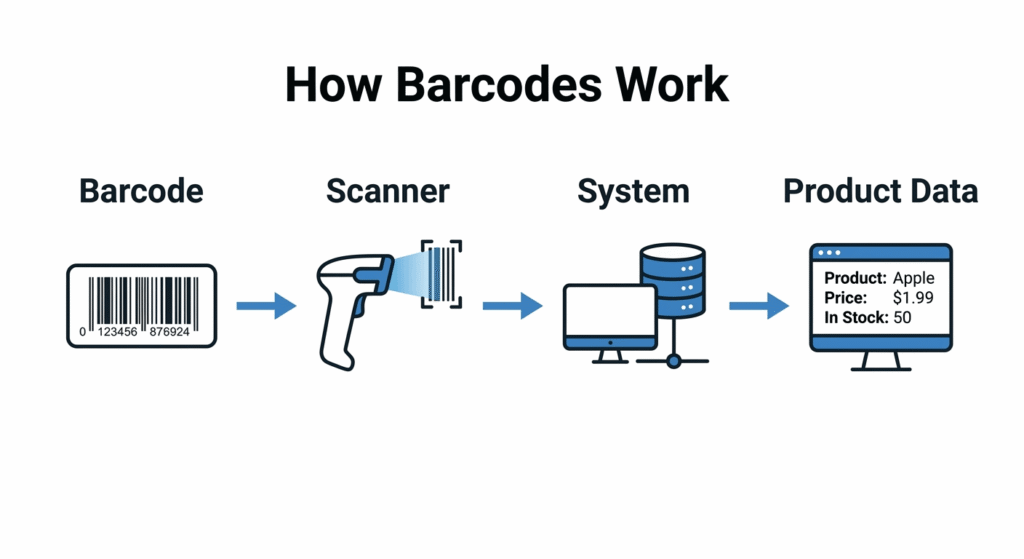
Barcodes work by converting product information into a scannable format that machines can read instantly. This process follows a simple real-world flow:
barcode is created → printed on a Barcode label → scanned → data is retrieved from a system
Each barcode is linked to a database, allowing businesses to identify products, track inventory, and automate operations efficiently.
Barcode Number and Data Encoding
A barcode number is the unique numeric or alphanumeric code assigned to a product. It acts as an identifier that connects the barcode to detailed product information stored in a system.
When a barcode is created, this number is encoded into a pattern of bars and spaces.
This encoded data helps businesses:
- Identify products quickly
- Manage inventory accurately
- Reduce manual errors
Barcode Formats and Data Structure
Different barcode formats are used depending on the industry and purpose. Each format follows a specific structure for encoding data.
Common formats include:
- UPC – used in retail products
- EAN – used for global product identification
- Code 128 – used in logistics and shipping
Each format determines how the barcode number is arranged and how much data it can store.
Barcode Scanning Process
The barcode scanning process is simple and fast:
- A scanner emits light onto the barcode
- The bars and spaces reflect light differently
- The scanner converts this pattern into a digital signal
- The system matches it with the product data in a database
This process happens instantly, enabling quick billing, tracking, and inventory updates.
1D vs 2D Barcode
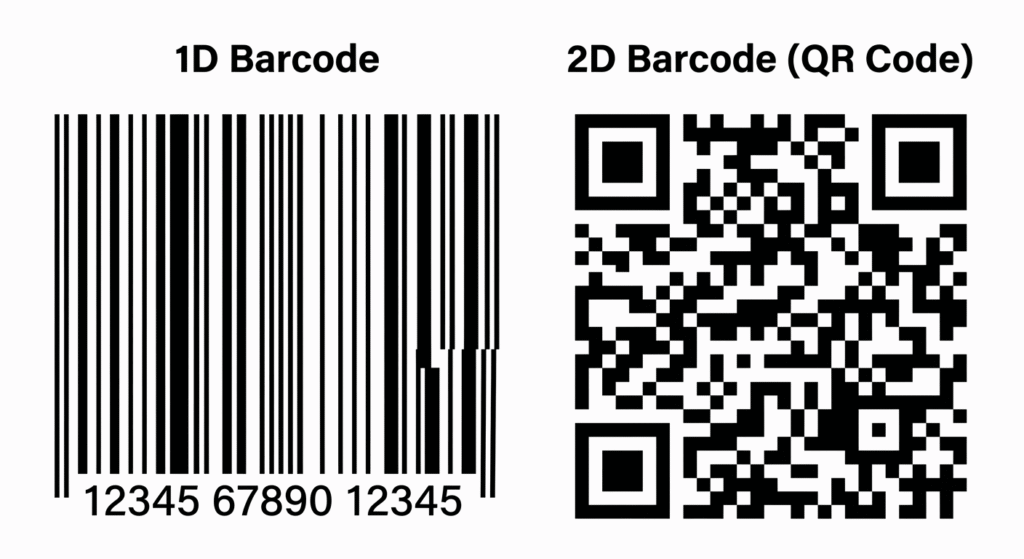
When choosing the right barcode, understanding the difference between a 1D barcode and a 2D barcode is essential. Both are widely used, but they serve different purposes based on data capacity, usage, and scanning methods.
The key difference in 1D vs 2D barcode lies in how data is stored and how much information each type can hold.
What is a 1D Barcode
A 1D barcode (linear barcode) stores data in horizontal lines and spaces. It is simple, widely used, and ideal for basic product identification.
Examples:
- UPC (used in retail products)
- EAN (used globally for product identification)
- Code 128 (used in logistics)
What is a 2D Barcode
A 2D barcode stores data in both horizontal and vertical directions using patterns like squares or dots. This allows it to hold more information compared to 1D barcodes.
The most common example is a QR code, which can store URLs, text, and other data and can be scanned using smartphones.
1D vs 2D Barcode Compariosn
| Feature | 1D Barcode | 2D Barcode |
|---|---|---|
| Data Storage | Limited | High |
| Structure | Lines (linear) | Patterns (square/dot) |
| Data Type | Numeric / Alphanumeric | Text, URL, multimedia |
| Scan Method | Laser scanner | Camera / smartphone |
| Usage | Retail, inventory | Payments, marketing, tracking |
conclusion:
- Choose a 1D barcode for simple product labeling and retail use.
- Choose a 2D barcode when you need to store more data or enable digital interactions like QR scanning.
Different Types of Barcodes
There are different kinds of barcodes used across industries, each designed for specific applications like retail, logistics, and manufacturing. Choosing the right one depends on where and how it will be used.These types of barcode labels vary in data capacity, size, and scanning requirements.
UPC and EAN Barcodes
UPC (Universal Product Code) is widely used in retail stores, especially for billing and product identification. It is commonly seen on packaged goods in supermarkets.
EAN (European Article Number) is a 13-digit barcode used globally for product identification, making it ideal for international trade and export businesses.
Both UPC and EAN are best suited for retail and global product distribution.
Code 39 vs Code 128
Code 39 supports alphanumeric data and is commonly used in industries like automotive and defense for internal tracking.
In Code 128 it is a high-density barcode that stores more data in less space, making it ideal for logistics, shipping, and warehouse management.
Comparison: Code 128 is more efficient and compact, while Code 39 is simpler but takes more space.
Other Common Barcode Types
- ITF (Interleaved 2 of 5): Used on cartons and bulk packaging in warehouses
- Codabar: Common in healthcare, libraries, and blood banks
- Code 93: Offers higher density than Code 39, used in specialized applications
- SCC-14: Used for shipping and logistics to identify cartons and pallets
These barcode types are mainly used in logistics, healthcare, and industrial environments where tracking and identification are critical.
Barcode vs QR Code
Understanding the barcode and QR code difference is important when deciding which one to use for your business. While both are used to store and retrieve data, they differ in structure, data capacity, and usage.
| Feature | Barcode | QR Code |
| Structure | Linear lines | Square pattern |
| Data Capacity | Limited | High |
| Data Type | Numeric / Alphanumeric | Text, URL, multimedia |
| Scan Method | Barcode scanner | Smartphone camera |
| Usage | Retail, inventory | Payments, marketing, digital access |
In simple terms, barcodes are best for product identification, while QR codes are better for interactive and digital use cases.
2D Barcode vs QR Code
A QR code is a type of 2D barcode, but not all 2D barcodes are QR codes.
2D barcodes include formats like Data Matrix and PDF417, while QR codes are specifically designed for fast scanning and higher data storage. QR codes are also more commonly used because they can be scanned using smartphones without specialized devices.
When to Use Barcode vs QR Code
Choose based on your business needs:
Use barcodes for:
-
- Retail products
- Inventory management
- Billing systems
Use QR codes for:
-
- Digital payments
- Website links and promotions
- Customer engagement
Decision Tip:
If your goal is internal tracking, go with barcodes. If you want customer interaction or digital access, use QR codes.
How to Choose the Right Barcode
Choosing the right barcode is essential for accurate tracking, faster operations, and smooth business workflows. If you’re wondering how to barcode my products, the answer depends on your industry, packaging, and data requirements.
Here’s a simple way to select the right product barcode:
Choosing Based on Industry
Different industries use different barcode types based on their needs:
- Retail (Supermarkets, Stores):
Use UPC or EAN barcodes for fast billing and product identification - Logistics & Warehousing:
Use Code 128 for tracking shipments and inventory - Healthcare & Manufacturing:
Use specialized barcodes like Codabar or Data Matrix for accuracy
Recommendation:
Retail = UPC/EAN | Logistics = Code 128
Choosing Based on Packaging
The size of your product packaging plays a key role:
- Small Packaging (medicine, cosmetics):
Use 2D barcodes as they store more data in less space - Large Packaging (boxes, cartons):
Use 1D barcodes as they are easy to print and scan
Recommendation:
Small space → 2D barcode | Large space → 1D barcode
Choosing Based on Identification Needs
Your data requirements determine the barcode type:
- Simple Identification (product ID, price):
Use 1D barcodes - Complex Data (URL, batch info, tracking details):
Use 2D barcodes
Final Decision Tip:
If you need basic product tracking, choose 1D. If you need advanced data and flexibility, go with 2D.
Barcode Applications Across Industries
Barcodes are used across multiple industries to improve efficiency, accuracy, and tracking. From retail billing to healthcare safety, they play a critical role in managing operations and reducing manual errors.
Retail and Manufacturing Use
In retail, barcodes are mainly used for fast billing and product identification at checkout counters. Each product barcode is linked to pricing and product details, enabling quick and error-free transactions.
In manufacturing, barcodes help in inventory management, raw material tracking, and production monitoring, ensuring smooth workflow and reduced losses.
Food and Healthcare Applications
In the food industry, barcodes are used for tracking batches, expiry dates, and product details, ensuring safety and compliance with regulations.
In healthcare, barcodes are critical for patient identification, medicine tracking, and error prevention, helping hospitals maintain accuracy and safety in operations.
Document and Asset Tracking
Barcodes are also used for tracking documents, files, and business assets. Companies use them to manage records, monitor equipment, and keep track of important items efficiently.
This makes barcodes a simple yet powerful tool for organizing and managing resources across industries.
Barcode Printing Essentials
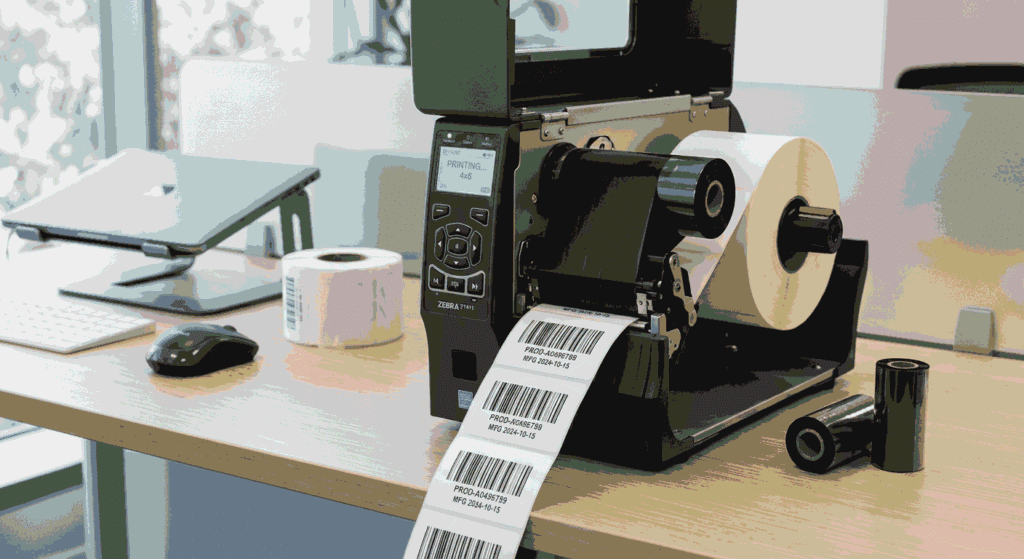
Implementing an effective barcode system requires the right combination of labels, printing technology, and equipment. Choosing suitable materials ensures better scan accuracy, durability, and long-term performance.
Types of Barcode Labels
Different types of labels are used depending on the application and environment. Businesses commonly use barcode labels for product identification and inventory tracking across industries.
For simpler applications, plain labels are used where basic printing is sufficient without pre-designed elements.
Printing Technology and Materials
The printing method plays a key role in barcode quality and durability. Thermal barcode labels are widely used for fast and cost-effective printing, especially in retail and logistics.
For long-lasting and high-quality prints, thermal transfer ribbons are used along with compatible labels, making them suitable for harsh environments and long-term use.
Equipment and Customization
A reliable barcode printer is essential to ensure consistent print quality and scannability. The choice of printer depends on volume, speed, and application requirements.
For branding and professional presentation, businesses opt for custom printed labels that combine design with barcode functionality.
Companies looking for durable and high-quality solutions often source barcode labels in mumbai from trusted manufacturers like Suman Labels, ensuring consistent performance and reliability.
Barcode Quality and Specifications
Barcode quality directly impacts scanning accuracy, system efficiency, and overall business operations. Poorly printed or incorrectly sized barcodes can lead to scanning errors, delays, and data mismatches.
To ensure reliable performance, it is important to follow proper barcode specifications, including size, print quality, and testing standards.
Barcode Size and Placement
The size and placement of a barcode play a crucial role in readability. A barcode that is too small or poorly positioned may not scan properly.
- Maintain proper barcode size based on industry standards
- Ensure enough spacing (quiet zone) around the barcode
- Place the barcode on a flat, visible surface
Proper size and placement ensure fast and error-free scanning.
Barcode Quality Standards
High-quality printing is essential for barcode performance. Clarity and contrast determine how easily a scanner can read the code.
- Use high contrast (black bars on white background)
- Avoid smudges, fading, or distortions
- Ensure sharp and well-defined edges
Good print quality improves scanning speed and reduces errors.
Testing and Verification
Testing is a critical step before using barcodes in real operations. Even small errors can cause scanning failures.
- Test barcodes using a scanner before deployment
- Verify readability under different lighting conditions
- Check consistency across multiple prints
Regular testing ensures that barcodes perform reliably in real-world environments.
Common Mistakes to Avoid
Avoiding common barcode mistakes is essential to maintain accuracy, efficiency, and smooth operations. Even small errors in barcode selection or printing can lead to scanning failures, incorrect data, and delays in your workflow.
Incorrect Barcode Usage
One of the most common mistakes businesses make is choosing the wrong barcode type for their specific use case. For example, using a 1D barcode where more data storage is required can limit functionality and create inefficiencies.
It is also important to follow standard barcode formats such as UPC, EAN, or Code 128. Using non-standard or incorrect formats can cause compatibility issues with scanners and systems.
Always choose the barcode type based on your industry, data requirements, and application.
Printing and Quality Errors
Barcode quality plays a major role in scanning performance. Poor printing can make even a correctly generated barcode unusable.
Common issues include:
- Printing barcodes too small
- Blurry or faded print quality
- Low contrast between bars and background
- Missing spacing (quiet zone) around the barcode
These issues can prevent scanners from reading the code accurately, leading to delays and operational errors.
Ensure proper print quality, size, and contrast for reliable scanning.
Security and Data Issues
Barcode systems rely heavily on accurate data. If the data linked to a barcode is incorrect or duplicated, it can create confusion and disrupt operations.
Problems often occur when:
- Barcode numbers are duplicated
- Incorrect product data is linked
- Systems are not updated regularly
Maintaining a well-managed database and verifying barcode data before use is crucial for long-term reliability.
Always validate your barcode data and avoid duplication to ensure smooth operations.
Conclusion
Choosing the right barcode is essential for efficient product identification, accurate inventory management, and smooth business operations. Understanding the different types of barcodes and their use cases helps you make the right decision based on your specific needs.
By selecting the appropriate barcode format, printing method, and quality standards, businesses can reduce errors and improve overall productivity. For reliable and high-quality labeling solutions, labels manufacturer in Mumbai Suman Labels offers products designed to ensure durability and consistent scanning performance.
If you’re planning to implement or upgrade your barcode system, choosing the right solution today can make a significant difference in your long-term efficiency.
Frequently Asked Questions
1. What are the types of barcodes?
The main types of barcodes are 1D barcodes and 2D barcodes. 1D barcodes include UPC, EAN, and Code 128, mainly used for retail and inventory. 2D barcodes like QR codes store more data and are used for payments, tracking, and digital applications.
2. What is barcode number?
A barcode number is a unique numeric or alphanumeric code assigned to a product. It is encoded into the barcode pattern and linked to product information in a database, allowing systems to identify, track, and manage items quickly and accurately during scanning.
3. What is a barcode reader?
A barcode reader is a device used to scan and decode barcodes. It reads the pattern of bars or shapes using light or a camera and converts it into digital data, which is then used by a system to retrieve product or item information instantly.
4. Types of barcode scanners?
There are several types of barcode scanners, including laser scanners, CCD scanners, and image-based scanners. Laser scanners are used for 1D barcodes, while image scanners can read both 1D and 2D barcodes, making them more versatile for modern applications.
5. How to read a barcode?
To read a barcode, a scanner emits light onto the barcode, and the reflected light is captured and converted into a digital signal. This signal is then decoded into a barcode number, which is used to retrieve product information from a database.
6. How to check and decode barcode?
To check and decode a barcode, scan it using a barcode scanner or a smartphone app. The system will display the barcode number and linked product details. You can also verify it using online tools or databases to ensure the information is correct.
7. Which barcode is best for products?
The best barcode for products is usually UPC or EAN, as they are widely used in retail and globally accepted. They allow quick scanning, accurate billing, and easy integration with inventory systems, making them ideal for most product-based businesses.